
How much does AI customer service cost? Compared with hiring one more employee
“There are too many messages to answer. Should I hire someone, or set up AI customer service?” Many shop owners struggle with this. This article doesn’t claim AI can do everything. Instead, it lays out the costs of three options side by side: answering messages yourself, hiring one more employee, and adopting AI customer service, and explains honestly when AI pays off and when you should still hire a person.
First, the hidden cost: owners answering messages themselves
At most small shops, “customer service” is the owner. It looks free, but it has two hidden costs:
- Time: if you spend 1–2 hours a day answering repeat questions like “What time do you open?”, “Do you have a table?” or “How much is it?”, that adds up to 30–60 hours a month. That time could go to quality, marketing or your family.
- Missed orders: messages late at night and at peak hours are the easiest to miss, and customers usually don’t wait. If nobody answers, they ask the next shop. What you lose isn’t a message; it’s an order.
The real cost of hiring a customer service agent
Hiring isn’t just a salary. As a rough estimate at typical rates in Taiwan, a customer service agent earns a little over NT$30,000 a month. Add the employer’s share of labor insurance, national health insurance and pension contributions, and the actual staffing cost is about 1.35 times the salary:
| Item | Rough estimate (per month) |
|---|---|
| Monthly salary (assumed) | About NT$32,000 |
| Employer’s labor insurance, health insurance and pension contributions (about 0.35×) | About NT$11,000 |
| Total staffing cost | About NT$43,000/month |
And one employee works 8 hours a day, five days a week, so late-night and weekend messages still go unanswered. True 24-hour coverage takes shifts, not one person, and the cost goes up again.
The cost structure of AI customer service
Adopting AI customer service has two main costs:
- AI customer service platform fee: no-code platforms like Chatbotta offer an AI knowledge base, a flow designer, a shared inbox and more, billed monthly by plan. The cost is usually in the thousands of NT dollars, not the tens of thousands. For Chatbotta, the Starter plan is NT$1,999/month with 300 AI conversations (about 10 customers asking questions a day), and the Growth plan is NT$6,999/month with 1,500. Both plans have the same features (both include the booking module), and all of one customer’s messages on the same day count as 1 conversation. See Pricing.
- LINE Official Account messaging plan: in Taiwan, from NT$0/month for light use; choose based on how much you broadcast. The key point: AI’s automatic replies to messages customers send you don’t count toward your LINE message quota, so AI customer service won’t raise your messaging bill. For how billing works, see LINE Official Account pricing explained.
In other words, the total monthly cost of AI customer service is usually a small fraction of hiring one more person, and it does something a person can’t: it’s on call 24 hours a day, replies to any number of customers at once, and never gets tired.
When does AI pay off, and when should you hire a person?
What AI is good at (best handed to a machine)
- Repetitive common questions: opening hours, address, prices, policies, stock checks
- Instant replies late at night, on weekends and at peak hours, so no question is missed
- Guided interactions: fixed flows such as bookings, collecting contact details and order lookups
What only people can do (hire when you need to)
- Complex complaints and disputes, which need judgment, flexibility and accountability
- Emotionally demanding conversations, such as calming customers down, apologizing and handling complex cases, where customers want to be understood by a person
- High-value, highly customized sales, which need expert advice and built-up trust
To be honest: if most of your messages are complex cases, AI can only help so much. But for most shops, most messages are actually repeat questions, and that’s exactly where AI pays off most.
The practical answer: AI answers first, people take over
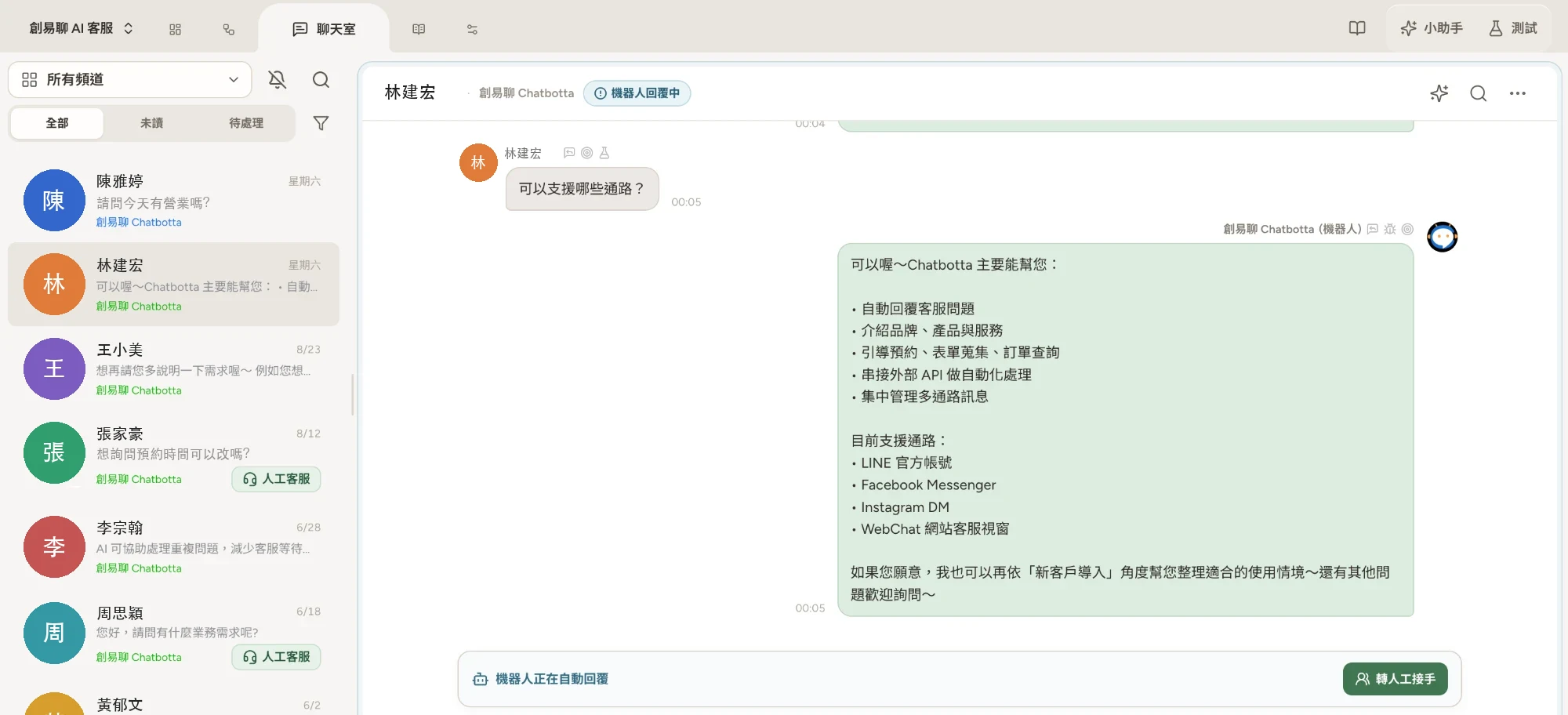
The most practical setup isn’t a choice between AI and people; it’s a mix: use the AI knowledge base to catch common questions and late-night messages, use the flow designer for fixed flows like bookings and orders, and use hand-off to a person in the shared inbox so conversations the bot can’t handle go to a person at any time. That saves most of the staffing cost without giving up the personal touch where it matters.
How to start: try it first
You don’t need to invest heavily up front. Chatbotta offers a 14-day free trial with hands-on help getting set up (extendable depending on your progress). Put your common questions into the knowledge base, run it for two weeks, see how many messages AI handles that would otherwise take your time (or be missed), then decide whether to keep using it.
Start for free, or book a free 30-minute product demo to talk about whether it suits your shop. For the full approach on LINE, see LINE AI customer service.
FAQ
Q: Can AI customer service fully replace human agents?
A: No, and you shouldn’t expect it to. AI is good at catching repetitive common questions and late-night messages; complex complaints and situations that need empathy and judgment still need a person. The practical approach is to let AI answer first, with a person ready to take over at any time, so your staff can focus on the conversations that truly need a person.
Q: How much does AI customer service cost per month?
A: There are two main costs: the AI customer service platform’s monthly fee, plus your LINE Official Account messaging plan (in Taiwan, from NT$0 for light use, depending on how much you broadcast). Because automatic replies to messages customers send you don’t count toward your LINE message quota, AI customer service itself won’t raise your messaging bill. The total is usually far lower than the cost of hiring one more person.
Q: Does a small shop with few messages need AI customer service?
A: If you get only two or three messages a day and can keep up, you can hold off for now. But many owners underestimate the messages missed late at night and during busy hours, and those unanswered questions are often lost orders. Try the free trial for a few weeks, see how many questions it catches that you would otherwise have missed, then decide.